← All case studies
PrototypeDACH Document Intelligence

German bank-detail forms read and verified, with zero wrong values let through.

European payments provider · DACH back office · Pilot-ready prototype · name withheld

0wrong values auto-acceptedMeasured
128 / 128fields read correctly in our testMeasured
−85%handling time per formTargeted
01
The problem

A European payments provider processes signed change forms from its German-speaking (DACH) merchants: new bank details, terminal swaps, payment mandates and pricing changes.

£What it was costing them

Hours of skilled back-office time per day, and the financial and reputational risk of a misdirected payment.

Read more

Forms arrive typed, scanned or handwritten, in German, in two different layouts.

02
The existing workflow

How the work was done, and where it broke.

It starts with

A batch of signed forms or contracts is uploaded: typed, scanned or photographed, up to 30 PDFs at a time.

What goes in

Bank detail change forms (two German layouts, 38 and 9 fields), with typed, scanned and handwritten entries and tick boxes.

Done by hand today

Reading each form, retyping every field and checking bank details digit by digit.

✕

Back-office staff retyped every field from every form, about 15 minutes each.

✕

One wrong IBAN digit sends a merchant's money to the wrong account.

✕

Handwriting, tick boxes and 'same as above' sections make simple OCR unreliable.

✕

Backlogs build at month end and after migrations.

03
The solution

Two independent readings before trust. Anything that doesn't agree, or fails a rule, goes to a person.

1Started from the risk

Defined the one metric that matters: no wrong value may ever be auto-accepted.

2Two independent readings

OCR reads every field; the AI model re-reads uncertain fields from the image alone, without seeing the OCR.

3Banking rules on top

IBAN checksums, BIC format, postcodes, dates and cross-field rules check every value.

4Measured before promising

Built an evaluation harness and scored every field on typed, scanned and handwritten samples.

☺
Where a person decides

A reviewer sees the page with a box on every field. Only flagged values need attention. Press J for the next issue, then confirm or correct, and approve the export.

04
Architecture

From input to outcome.

1

Inputs

  • Scanned, typed and handwritten PDFs
  • Bulk upload, up to 30 at once
2

Ingestion

  • Pages rendered to images
  • Cloud OCR and text extraction OCR: forms, tables, tick boxes
  • Cache by file fingerprint, each PDF read once
3

AI layer

  • A large language model on a managed cloud AI service reads cropped field images independently
4

Rules

  • IBAN checksum and OCR-confusion repair
  • BIC, postcode, date and email checks
  • Cross-field consensus rules
5

Human review

  • Page view with a box per field
  • Only flagged values need a decision
6

Outcome

  • Approved CSV or Excel export
  • Per-document run record
05
Integrations

Works with the systems already in place.

⇄

Export to CSV or Excel for the customer's core system import

⇄

Production integration to the target system to be scoped

06
Business value

What changed for the business.

Zero wrong values auto-acceptedMeasured

Every value that passed without review was correct.

84% of fields need no oneMeasured

Only 14% went to a person for a second look, and every one of those values was in fact correct.

15 minutes → about 2Targeted

Reviewers check highlighted fields instead of retyping whole forms.

Import-ready outputMeasured

A fixed set of columns per form, exported to CSV or Excel for the core system.

What it could be worthIllustrative
217 ha month at 1,000 forms
433 ha month at 2,000 forms
1,083 ha month at 5,000 forms
How we worked this out

At about 13 minutes saved per form (15 by hand, about 2 to check). Your volumes and costs will differ. Illustrative, built on the targeted −85%. Measured on the customer's own forms in a pilot.
07
The evidence

Shown on real work.

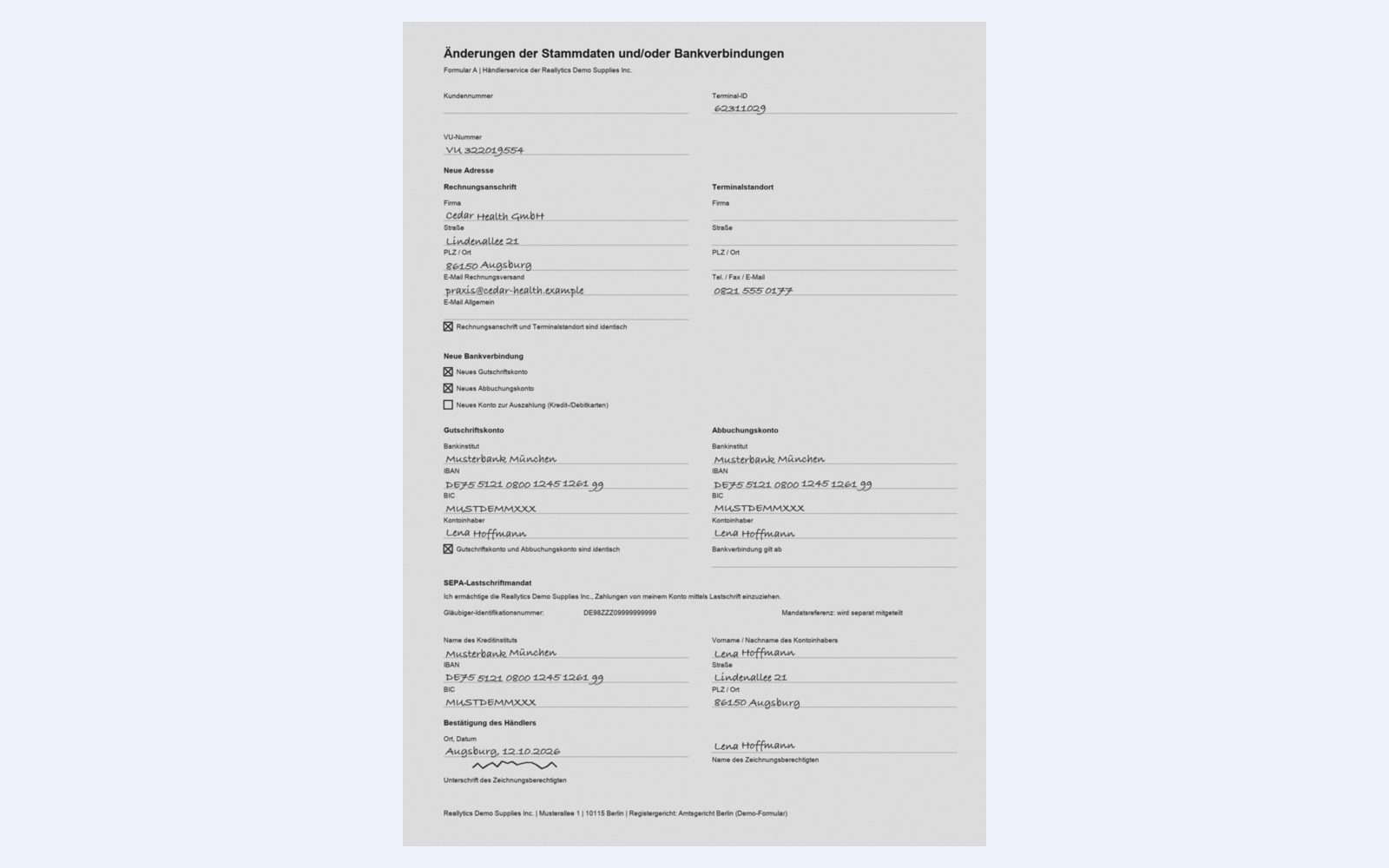
A handwritten German bank-detail change form with an empty 'terminal' section covered by a 'same as above' tick box. The tick box was honoured and all 34 fields were correct in our OCR-plus-rules test, with no wrong value auto-accepted.
About the evidence

Accuracy was measured on 5 fictional sample forms with OCR plus rules. A pilot re-measures on real customer forms.

How we label results

Have a process like this?

Tell us about it. The first discovery call is free.